The Truth About Starfish
By Jennifer Harvey
From somewhere along the shore I hear my mother calling to me, the sound of her voice mingling with the screech of gulls and the swish of waves. I know I should call back to her and ease her anxiety, but instead I remain crouched behind the rocks and wait for her to walk by.
Overhead, the sun is climbing higher and slowly bleaching the blue from the sky. The harshness of the light forces my eyes shut, and in the orange glow of my eyelids I imagine my mother transformed into pale grains of sand that are washed far out to sea. Even though I know it’s wrong, the idea of her being carried away by the ocean appeals to me.
This past year, my mother has become nervous and troubled by her imagination. She has told me, at least once a day, that I need to stay close by at all times and that I must always be visible. Whenever I stray too far, she gets nervous and starts calling out to me.
The beach in particular is apparently a treacherous environment. The waves, the sea, the sky – where I see the potential for adventure, she sees only danger. I miss the way she used to be, and it’s confusing sometimes to see her standing before me and not recognise her. It’s as if all her colour is gone and all that’s left of her is this dull, lifeless version.
If I were to ask her ‘What are you so afraid of?’ she would never tell me. She is one of those people who believe that if you speak of a thing, you bring it forth, your words and thoughts conspiring against you to manifest the thing you fear most.
It’s one of the ways we differ from one another. I can wish her cast away and fear nothing. Because it’s just a silly wish. I know it will never happen.
Yesterday, when I strayed too far, my father had scolded her for her nerves. ‘Oh, for goodness’ sake, Helen. Let the boy run free if he wants to. He’s twelve now, not some toddler.’
Her cheeks had flushed an apple red, and I wasn’t sure if it was the colour of shame or simply the pressure she was containing as she wrestled with the urge to contradict him in my presence. My father had winked at me. Permission to go. Permission to pretend it doesn’t matter that they bicker and mutter and tut. But it does. And, sometimes, that’s why I run. Sometimes that’s why I hide behind rocks and giggle when I hear the panic in her voice. Sometimes that’s why I utter a prayer and imagine for a moment that it really can bring something forth. Sometimes I am more like her than I care to admit.
I hear her call again, her voice growing fainter as she heads down the beach. But my father is right, I am not a child anymore, and I can run if I want to. And I can hide, too.
When I am certain she cannot see me, I stand up and catch sight of her in the distance, a silhouette against the shimmering haze. She looks so small and lonely that, for a brief instant, I want to run to her and say, ‘It’s alright, I’m here! I’m right here.’
Instead I wait for the moment to pass, then head back to the rockpool where I immerse myself in a new world I have discovered. A world where parents, and all that troubles them, do not exist.
I prod my stick into the water and watch as the colours flash red, green and gold. I see the stick bend and know that this is what is called refraction, and I wonder how such a dark hollow can be so vibrant and alive, how it can terrify and fascinate me at the same time.
Below the surface, a mysterious world lurks, filled with strange, half-imagined creatures. I watch them scurry for shelter in the nooks and crannies as I peer and poke and prod. The seaweed knows a fabulous trick. Black as liquorice when it floats beneath the water, but when you pull it free and hold it up to the light you see it is actually a dark bottle-green, a transformation which always makes me gasp. Nothing is ever as it seems. There’s this world on the surface, with all its colours, and there’s another world below. But I try not to think about that as I spend the rest of the morning pulling seaweed from the water, making sure the magic has not lost its power. Black, green, black, green, bladderwrack, bladderwrack.
That’s the name for it. I looked it up in the book my father gave me: Rockpool Life.
‘Here,’ he said when he handed it over. ‘I’ve a present for you. Everything you need to know is in here.’ The gift tarnished in the giving, because I understood what had been left unsaid: ‘Don’t pester me with your endless questions. We’re here to relax and enjoy ourselves.’
I’d looked up the seaweed first and stared at its improbable name until curiosity shifted to boredom and I ran across the sands shouting, ‘Bladderwrack, bladderwrack,’ the word as satisfying as the thwack of my feet on the wet sand. My father stood on the beach, facing into the sun, his hand shielding his eyes as he watched me. I knew what he was thinking: why are you such a strange boy? And his presence made me run faster and faster. Because I know in these moments, he thinks of my brother. I know he wonders if he would have preferred to watch Alfie running along the shore, rather than me.
Alfie. I only know him now from photographs. Perhaps there are memories buried deep someplace, but I have yet to find them. For now, Alfie exists as a smiling face encased in silver picture frames, a solid, gleaming edge from which his image cannot escape. On Sundays, my mother polishes them and takes care to return them to their place on the mantlepiece.
In the photograph I like the most, he is three years old, and he is sitting on a piebald pony, squinting at the camera and smiling. I can conjure that image at will. Some days, I imagine I am sitting astride that pony with him, my stomach churning with excitement as he kicks the flanks and the pony shifts from trot to canter. We would have done this, I’m sure of it. And my mother would have watched us, and she would not have been scared.
Alfie, my brother. I always call him that because I have to remind myself. My brother. I had a brother.
No one talks about what happened to him. I guess there are no words to explain a thing like that. It’s not something you can look up. There are no books that can describe what it is you are feeling. You must learn it yourself. Even the dictionary fails. Mourning, grieving, trauma. I had heard people use those words when they spoke of my mother, but when I searched for the definitions in the dictionary, they sounded flat and untruthful when I compared them to her eyes, to her face. No, I thought, that’s not what she feels, that’s not how she is. It is more than this. But what it is, I still can’t say. Because how do you describe a person that is missing such a huge part of themself?
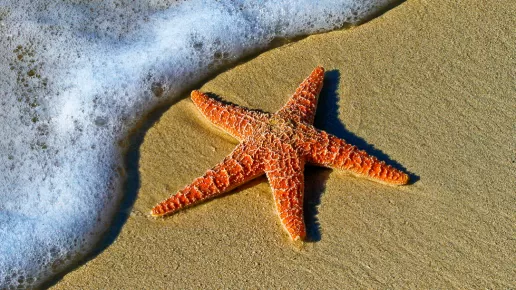
Rockpool Life doesn’t tell you everything, either. My father was wrong about that. There are some quite important things it forgets to mention, like the truth about starfish.
I reach into my pocket and pull out the one I found yesterday. Then, it was plump and alive, its underside shivering. The book says there are eyes at the end of each limb, and I looked but couldn’t find them. If a starfish loses a limb, it can regrow it. It can heal in ways we cannot understand.
But the book didn’t mention that, out of water, a starfish soon shrivels and dies. Or perhaps I simply chose not to read about that. I preferred the feel of it in my hand. The fact that I had found it and pulled it free from the water. Mine to have and hold. Mine. My starfish. With the power to rejuvenate.
But it didn’t belong to me, and it didn’t belong here on the surface, either. This world and the world of the rockpool are very separate places. Things can live in one or the other, but never both. They are contained universes. Just like Alfie, wrapped up in his silver picture frames. He belongs somewhere else now, too. And what happened can never be undone.
I look at the starfish in my hand and consider a prayer as I drop its desiccated body into the water, but all I manage is a whispered plea as I try to coax it back to life. ‘Live. Please, live.’
But no magical transformation occurs. The colour does not shift from white to pink, the eyes do not blink open at the end of each shrivelled limb, the underbelly does not begin to shiver. I kneel at the water’s edge, gaze into the pool, and try again.
‘Live. Please, live,’ I say, and consider a new incantation. Black to green. White to pink. The possibilities contained in a name.
‘Bladderwrack,’ I whisper. A final plea. I wait, but the starfish does not understand. I watch as it sinks to the bottom of the pool, where it stays, pale and unresponsive, then I lean over and slip my head beneath the water, keeping my eyes open and feeling the sting of salt as the water fills my ears and dampens the sounds of the world beyond.
You can drown in shallow water. I read that someplace and asked my mother if it was true. She had stared at me and nodded, then walked over to the dresser, picked up a photograph of Alfie and whispered something I didn’t hear. But she seemed to accept it was true. ‘It doesn’t take an ocean,’ she said. Then we never spoke of it again.
The thump of my heart grows louder and louder until I cannot fight the need for air. When I pull my head from the water, I hear my mother calling to me. I hear the panic in her voice. She is close to desperation now, but I am too ashamed to answer. Instead, I watch as the starfish mingles with the tangles and folds of bladderwrack, its pale white body disappearing as it is reabsorbed by this secret world. A world that cannot be deciphered with books. A world a boy like me can never hope to understand. A world the starfish knew I had no right to enter. And I think Alfie knew it too, that there are places where we should fear to tread. One or the other. But never both.
‘Peter! Peter!’
I should let her know I am safe. I should shake the sand and the seaweed from my hair and stand up and wave. I could calm her fears with one smile and a few words. I could tell her what I learned today, help her see that this is where we are, for now, and that that’s okay. We have no need for mystery or magic tricks. No need for books or definitions. Everything can be made right with just a smile and a wave.
I could tell her that one day she will break the surface and come back to us, altered, but whole and complete, and I will recognise her again. I can tell her about the starfish. How, caught between two worlds, my head under the water and the salt stinging my eyes, I thought I saw it twitch and the colour seep back into its shivering legs, rejuvenating as I pulled my head out of the water and filled my lungs with air, getting ready to call to her.
‘It’s alright, I’m here! I’m still here.’
About the Author
Originally from Glasgow, Jennifer Harvey now lives in a small coastal town in Denmark. She is the author of three novels and her short fiction has been published widely in literary journals and anthologies. When not writing, she can be found walking with her dog on the beach.
Find her website here.