Lie Dream of a Casino Soul
By Madeleine Foster
I can’t think back to Blackpool without hearing Northern soul. Not just the music. Not just the classics: The Temptations, Gloria Jones, Frankie Valli, The Elgins, Frank Wilson. Bursting, rapturous, raw music – music rich and crimson and pulsing. Lyrics I’ve forgotten, voices who’ve sung their last.
But also the sound of the dance floor. The brogues squeaking across scuffed ballroom wood. The whir of bodies twirling, legs high-kicking, hands hammering as dancers backdrop against the ground. Voices singing – earnest and frayed – from the cusp of life itself. From somewhere illusory; somewhere beyond life.
And the sound of chatter as sweat-soaked soulies jostle out the doorway and descend into that dank seaside nighttime. The echo of lost friends as they head home, or hurry off for the coaches towards Wigan, their once-cherished faces obscured by streetlights or time.
I was the right age when I chanced upon it. I was craving countless things: other places, soundscapes, vistas. New, glossy, gorgeous people. A small but enviable life. The perfect age for Northern soul to come hurtling in, clattering at my feet through a wedged-open window.
Liz had only just moved into the flat below mine. It was a pebbledash, post-war terrace that the landlord had split so that we only shared an entranceway. It was mouldy, too, and tired, making it cheap enough for two twenty-year-olds to rent alone.
I heard the music before I saw the girl. I half wonder if I’d have been so besotted by her if it weren’t for the sound of those songs swirling around her room.
It was the last Friday of May 1974, and I had just walked home from my job at a café (a walk I can visualise even now: the low, red-brick walls, the sparse trees, the bus stops with their sad, hollow lights). I smelled of vinegar and the evening air was bright, a dappled purple gloaming. The first evening of summer – that feeling like it’s always the first summer on earth. I was deep and lost within it all as I approached my flat, and I heard the twang of a guitar, cascading and sharp-edged.
Then, a voice, crackling and deep-grooved. ‘There’s a ghost in my house,’ it sang. ‘The ghost of your memory.’ Shimmering, insubstantial – a voice eerie and melancholic as a fog. Truthful as anything.
I hovered by the doorway and listened the whole way through. And when the song ended, I lingered on as the needle was lifted and replaced, and it spun all over again from the start.
I heard a rich, low voice singing along – a woman’s voice – the sound of her breath tangling in the net curtains. ‘I just keep hearing your footsteps on the stairs, when I know there’s no one there, you’re still such a part of me.’
Both voices merged with a sort of dispassion. A cool abandon, as though helpless against ghostly heartache. I peered in through the curtains, a white gauze shrouding an orange room, and saw a figure within, strewn across the bed. The dark shape of her, like ivy, like cracks in stone.
When the milk van did its rounds a few days later, leaving our bottles sweating in the early June sun, I saw my opportunity. I took her pints and kept them in my fridge until I heard her key rattle in the door. Then, bottles clammy under my arm, I knocked on her flat. And she was lovely, of course – why else would I remember her so well? Cropped brown hair, ruddy, high cheekbones, a little chubby, large, dark eyes – one slightly lazier than the other. A playful gleam in her stare.
From there, we talked often: passing in the hallway, or taking out the bins at the same time, or knocking on and asking to borrow ingredients for cupcakes I never baked. I told her about customers I served at the café, and she told me about her days spent behind a reception desk.
After a short while, I asked about the music she was listening to. I remember she’d caught me after work, approaching our doorstep, and I was talking to her through the ground floor window. She must have just woken from a nap, her hair matted, her pinkish cheek rutted by her pillow. Some of her eyeliner had gathered in the corner of her eye, and her voice was languorous and low. Motown, she told me, pushing her window open wider. Northern soul.
‘You should come along,’ she said. ‘Me and my friends go every week. The more the merrier.’
‘But I don’t dance,’ I said, a shrill feeling in my stomach.
‘That’s okay, you’ll pick it up. I’ll help you out.’
I grinned in response, heat prickling my cheeks.
‘It’s every Saturday from eight. At the Mecca. The Highland Room,’ she explained.
‘Okay.’
‘Dress smart,’ she said, her face in the palm of her hand, a riot of loveliness. ‘Brogues and a shirt. And make sure your trousers are comfy. Comfy and wide.’
I felt dizzy on my way up to my flat – ridiculous, already ashamed. I knew I couldn’t go. It was preordained. By nature, I supposed. By some colossal meekness which I bore like a saint. And when Saturday came and went, I avoided Liz for as long as possible, huddled behind my door, tracing the sound of her footsteps, the thud of her leaving the house. I would’ve gone on cowering forever if she hadn’t caught me before the week was out.
‘Where were you?’ she asked, catching me in the hallway as I lugged home three bags of shopping. I offered an excuse – a friend, I said, had gone through a break-up. Needed a shoulder to cry on.
‘That’s a shame,’ she said, and – casual as anything – took one of the bags from my hand. I was self-conscious as she trailed me up the stairs, back taut, unable to move naturally. I wondered if my flat was clean.
She helped me unload my shopping – unhurried, bizarrely intimate – and asked if I would be free to join them at the Mecca the next day.
‘Course,’ I said, wiping crumbs from the counter when her back was turned. ‘I’d love to come.’
‘I’ll have to meet you there,’ she said. ‘I’m visiting friends in Manchester during the day. But we’ll be there later on.’
I followed her to my door. ‘Okay.’
‘You promise you’ll come this time?’
‘Yeah, I promise.’
‘No more excuses?’
‘No more excuses.’
She hugged me – brisk, sweet, perfumed – before descending the stairs. Moments later, a lovelorn song drifted through the hallway.
I teetered in my doorway for a while, just listening. To hell with meekness, I thought. To hell with predestiny. To hell with shame. She had been in my kitchen, her hands gracing my cupboards, her thighs rested against my sink. I understood, suddenly, the lure of forever. The potency of it.
Shopping still strewn across my kitchen, I tore through my wardrobe in search of an outfit. I grabbed some flared jeans and a plaid Brutus shirt, then scrubbed at my scuffed loafers with water from the sink. I could’ve keeled over, lost in daydreams of whatever could be. The melodiousness – the rhythmic, leg-bobbing, rich-toned, pulsing earworm of wanting.
*
It was still light the next evening as the Mecca loomed into view. An eyesore slab of concrete bedecked with white plastic stars, its swooping red lettering redolent of Vegas-style, jaded glitz. Almost brash in its honest ugliness. Concealing the marvels that lay within.
I lingered across the street for a while, and watched as couples and friends filed inside. Twenty minutes passed with no sign of Liz. Not far off, I could hear the crackle of the sea at high tide. I began to worry that she was already inside, perhaps – hope against hope – waiting, watching the door for me. And so, feeling queasy, I crossed the street, stepped inside, climbed the creaking stairs towards The Highland Room, paid my entry, and crossed the threshold.
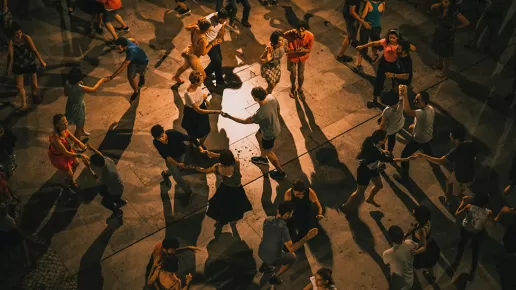
The room was small, with a low mezzanine and red carpets. Encircling the central wooden dance floor were clumsy rows of tables and tattered chairs, bodies strewn over them, limbs pouring over others’ laps, elbows in spilled drinks, heads rested on coasters in total, sticky exhaustion. It was barely past 9pm but every inch of floor was packed out, bodies moving in a glorious cacophony, at once wild and precise.
I scanned the room for any sight of Liz, but it was impossible. I knew I needed to wade in. But I held back for as long as I could, watching from afar. Even dancers who had come along in couples or groups seemed lost in their own movement, the mercury light of the disco ball shattering across their faces. Barely anyone smiled or laughed, their mouths and eyes downturned in a marble-like reverence. Gleeful, certainly, but beyond all pretense. They were like marionettes strung up and tossed around by the rhythm. Totally adrift.
It was easy to join the swirl of bodies undetected. Less easy, I discovered, to follow suit. I tried to drag my feet along in a smooth shuffle, clapping my hands jaggedly off-beat, and found my shoes would stutter, my movements fumbling. I started to spin, if only to escape the horror of shuffling, seeking comfort in the blur of the room as it galloped around me. But my arms felt lost and purposeless. I gazed in awe as dancers tossed theirs towards the ceiling, and felt the urge to cry. And when someone high-kicked – their foot inches from their own face, deftly cutting the tight space between two neighbouring soulies – I laughed aloud.
The dancer jerked back to his feet and stared me down. I blushed, instantly regretful, frozen and unable to shake his gaze. But then his face softened, his dark skin crinkling as he grinned – knowing, pitying.
‘You new?’ he yelled, the first line of a new song bursting atomic above us.
I nodded, still too sorry to speak.
‘You’ll be fine,’ he shouted. ‘Look, try this.’ He tapped one foot forward, then sideways, the other following suit. His movements were slow, at odds with the dancers around us. I followed obediently, wincing. We swayed together for a while, gradually picking up speed.
‘Good!’ he bellowed. ‘Now this.’ He slid one foot forward twice, then the other, and I followed. Next, he slid a foot back, the other twisting on its heel – Chaplinesque – then swapped sides, faster and faster, toe to heel, toe to heel, knees pulsing. I stumbled along, shoulders tense and embarrassed, until I collapsed into an odd flow.
Then he switched up, stomping forward, balancing on one leg until I followed suit. We laughed as we hovered together, legs behind us like ice skaters, before he tumbled backwards again on his toes. From there, he threw everything together at ludicrous speed. I trailed behind, my arms wheeling, my skin hot. Our bodies tangled once or twice, limbs clattering until we both hit upon the song’s rich-toned beat. More confident then, I folded my body into it, letting it contort me, letting it become everything. And suddenly it was easy – fun, even. Luxurious. And then the song ebbed away, and in the newfound, short-lived quiet, the man leaned close to me, the smell of his sweat sweet and sharp.
‘Just let go,’ he said. ‘Your body knows how to feel it. Let go.’
He was lost in the crowd before I had a chance to reply. I craned my head around in search of Liz, but couldn’t penetrate the slosh of bodies. Everything glinted, and the music rose again, the voices vast, agonised, the drumbeat piercing, the keyboard crazed. It bashed me like a sleep twitch. I was helpless. I shut my eyes and trailed my body as it swung and stamped and tossed itself, twirling and artless. The joy of it was near-violent, my forehead wet, the burning of my muscles sumptuous.
Two songs hurtled by and I was no longer thinking about Liz. I wasn’t thinking about the café, or the damp in my bedroom, or how much weekend was left. I wasn’t really thinking about anything. I was gloriously dumb. It felt like my skin might burst, like I was the first person on earth to discover music – to let it shatter me, to feel how it tugged apart the air. Every word in every line felt purposeful, and wise, and enduring. Every note and trill and thrum and chord so incomprehensibly clever. How could something so beautiful, I wondered, be so commonplace? So attainable? So close at hand?
I succumbed quickly and danced for an hour, maybe more. Before long, I was attempting high-kicks, blood pounding in my temples as I half-arsed backdrops and spins. I knew I looked ridiculous and I didn’t care. Nobody did. It was like none of us were even there. All of it constructed, somehow. Defiant. The colours vivid, the faces wonderful.
When I began to feel ragged, I stumbled to the stairway and headed outside. The cold and rain were luscious, and smokers huddled under the Mecca’s jagged awning beckoned me to join them, offering me a light. I raised my face and let the streetlights blur as I smoked, the sweat on my skin loosening. My breathing was hard for a long while, my heart freewheeling, my blood warm. I laughed along to the easy chatter of the other smokers. I loved them. I loved the tinny muffle of music above us. I loved every passerby. I loved the distant churn of the sea, the thought of all the faraway places it touched. It was a new kind of happiness – a rare reminder of life’s grip.
Then a voice cried out to me. ‘Hey!’
I turned and spotted a trio of figures ambling towards the Mecca, shrieking at the rain. They were tipsy, their flares draping through puddles flecked fluorescent by oil. The girl in the centre was waving to me, childish and exaggerated.
‘Liz!’ I shouted, the cigarette dropping from my lips as I grinned. A huge grin – deforming, embarrassing, completely merciless.
‘I’m so sorry!’ she said, stopping right in front of me. Her wet hair clung to her face, her cheeks burnished red. She wore thick eyeliner and lipstick and looked stupidly gorgeous. ‘Our train from Manchester was late.’
I brushed it off and she introduced me to her friends, who shook my hand and smiled, their pupils wide. Still a little breathless, I asked about their day. They had been record shopping, they told me. Found some gems. Liz’s friends talked me through some of their finds, and I nodded and gasped, cataloguing the names for later. All the while fixed on Liz’s face in my periphery.
‘Have you been inside already?’ she asked.
‘Yeah,’ I said. ‘It’s lively in there.’
‘You’re not too knackered?’
‘Course not.’
Brave and exhausted, I grabbed her hand and led her back inside. Her friends locked eyes knowingly, then ran ahead and disappeared into the Highland Room. From the stairwell, I could already hear the music blaring – the surging, aching, beating chorus of yesterday and forever. I turned back to see Liz smiling, her eyebrows raised, her eyes huge and beaming. And as we approached the club door, she squeezed my hand.
I saw it all laid out ahead of us: our bodies close on the dance floor, her laughing head collapsed on my shoulder, the crush of our faces as we kissed in corners before the lights turned on. Next Saturday, and the next, and the next. The soundtrack to every moment heavenly. And how I’d spin it all over and over again – every glimpse, every verse, every ghost of my memory – even after the club and the songs and the pebbledash house and the town (as it was then) and even the girl were long gone.
About the Author
Madeleine is a writer and museum professional based in Manchester, UK. Her fiction has appeared or is forthcoming in The Argyle, Fairlight Books, The Brussels Review, Scribbled., and Hemlock Journal. In 2024, she achieved third place in a short fiction competition held by Confingo Publishing. You can find out more at madeleinefosterwriter.co.uk.