Pressed for Meaning
By Becky Jones
Blue and violet criss-cross lines bulged across my grandma’s shins, like a tube map of her journey through this life. A metaphor I’d always liked because it made everything seem navigable, even when it wasn’t.
‘Use them or lose them, Rose,’ she would joke. Usually after we’d spent too much of the morning sitting on her deep-cushioned sofa, the strokable velvet one you could draw patterns in with your fingertips.
She’d be talking about her legs, but really this advice from her doctor could be applied to all sorts. I didn’t realise then how much she was trying to hold on and not say goodbye to movement, to meaning, to the parts of herself that still worked. I realise it now, of course, which feels both timely and too late.
And so we’d move. She’d circle her feet one way then the other, and we’d head outside to stretch our legs, venturing to the local shop for the weekend paper, a few supplies, and the lemon sherbet sweets that fizzed and sparked on our tongues.
Her phrase loops round my mind now as I pace the hallway. It’s early, but I can’t wait in the house on my own any longer. The interview’s not for a while, so I decide to walk the long way into town through the park and along the river – legs twitching, breath shallow, bag with my CV inside clutched tight as if it might try and make a break for it without me.
The summer grass is long and splattered with daisies and buttercups. The dandelions stand tall, ready to be picked and blown for wishes. I pause, but no wish today. I’ve wished here before and watched them all float off – for a job to love, a purpose, a version of me I’m proud of. For an answer that sounds impressive when someone asks, So, what do you do? and for the follow-up that stings: But what DO you do all day now the kids are at school?
I continue along the path, passing a man standing upright on his prayer mat in the shade of a tree, palms turned up towards the sky. An offering of good intentions, perhaps, humble deeds, his whole self. I wonder what it feels like to know exactly what you’re offering, and to whom.
His audience, a field of crickets, sings loudly in approval. I’m tempted to join in, to sit down facing him to feel something sacred, but his eyes are closed and my shoes might get muddy. He looks spent but rooted, at peace. I envy him. I’m a bag of nerves and untapped possibilities scattered like confetti in the breeze.
The route ends at the bustling market square. I check my watch: still early. Alongside a warm welcome, the church entrance opposite is advertising free Wi-Fi. I’m not sure why that’s necessary. Have we digitalised prayer now, too?
I’m drawn to it anyway, not to pray but for a moment of calm – the quiet pause before a leap. ‘There’s something special about a Sunday, Rose,’ my grandma used to say. ‘Peaceful. Spiritual, even.’ I never shared her faith, but she believed it meant something that I was born on the holy day. I’m still trying to work out what my meaning is.
Churchgoing aside, gardening was her true devotion. Daffodils lined her wraparound front garden announcing spring’s arrival each year. She’d shrug off her winter coat and head to the back, where oversized tulips jostled with lavender bushes and climbing roses. Snapdragons, pansies, peonies; everything blooming at once, unapologetic. Meanwhile, I’d sit nearby, weaving daisy chains into crowns, our small kingdom blooming beneath a sky of soft light.
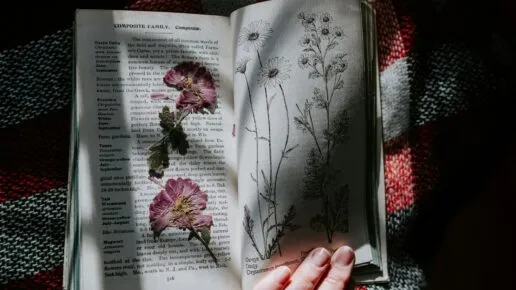
On wet days she pressed flower clippings into parchment notebooks as though hoarding tiny treasures – fragments of colour against the endless grey. She’d smooth the lining paper with her palm, slow and deliberate, like calming something wild.
I remember one rainy afternoon when everything felt like it was falling apart: school, a best friend, a boy we both liked, a stupid love note sent to her, not me. My grandma took some cuttings from the garden and showed me what to do, starting with the daisies. Guiding me to focus on the petals, the soothing texture of the paper, the white space to create.
‘You know, Rose,’ she’d said gently, ‘daisies are tough little flowers. They don’t look it, but they can grow almost anywhere. You’ll find them in nearly every country in the world. That’s what makes them special.’
I’d rolled my eyes, still tearful, still stinging with humiliation. ‘Daisies are not special, Grandma. They’re just common. That’s why they’re everywhere. Urgh. I’m too old for this. It’s so lame.’ Shoving the book aside, I’d stormed off to fix my smudged mascara, hating everything and everyone. But something stayed – the patience, the care, the act of saving what might otherwise fade. The quiet resilience.
The memory is making my eyes sting again now. And suddenly I feel like an imposter, just as I have in every job application lately. Where all the accomplishments that were mine have felt like they belong to someone else.
I move on, doing a final lap of the square before arriving at the front desk for my interview. The receptionist greets me with a wide smile. ‘Hello. How can I help?’
I smile back, but it feels like a performance already. I wonder if she really sees me or if I’m just another candidate. I tuck my hair behind my ear, then change my mind and untuck it.
‘Hello. I’m here for an interview with Ed Spencer. It’s Rose. Rose Carter.’
‘Just have a seat here, Rose, and I’ll get someone to meet you.’
I sit but immediately want to stand again. My legs are restless. I press both palms onto my knees to steady them, like I’m asking my body for cooperation.
In the interview room, a framed mission poster reads People First in a bold font, slightly faded. I make a mental note not to read into this.
Ed begins with, ‘Tell me a bit about yourself, Rose. What’s interested you in this role? And why now? I can see you’ve had a bit of a career break.’
He has a steadiness about him, like a chair that never wobbles. Freckles fade across his cheeks like ancient constellations. Still, I freeze. The phrase ‘career break’ feels like a polite way of saying ‘you’ve disappeared’.
I didn’t mean to leave it so long, I want to say. But somehow, I did anyway.
‘Um, yes, that’s right,’ I say instead. ‘I have been on a break. I had my two children and was busy raising them. But they’re older now, both at school. And I’m ready to return to work.’
And I don’t know why, I want to confide, but I feel like even though I did my best, somehow I still lost. My identity. My career. My ambitions. Now them. They love me, of course they do. But I’m just Mum. The keeper of their childhoods as they pull away, racing to young adulthood.
‘I’m keen to make use of my skills,’ I continue. ‘As you can see on my CV, in my last company I was on a fast-track leadership programme and won an award for my talent management initiative.’
I don’t mention the promotion I turned down after returning from my second maternity leave. Full time only. No flexibility. They never asked again. I left soon after – the punishing commute, the nursery fees swallowing my salary whole. Later I found out the role went to a colleague. A man. More junior than me. I still wonder if I closed that door or if it was quietly closed for me.
I told myself it was fine, that it was my choice, that I’d come back when I was ready. But while I paused, the world moved on.
My palms dampen. I twist my wedding band slowly, like I’m trying to unlock something extraordinary. I can do full time now, I tell myself. I’m not the woman who said no and watched the door close. Not this time.
‘Use them or lose them,’ I add, forcing a smile. ‘My skills, I mean. It just feels like time.’
‘Absolutely,’ he nods. ‘I can understand that. Well, as you already know, this is a new role in the HR team. We’re looking for someone who can come in and make an immediate impact with our people development plans. It’s full time and it’s fast-paced. Does this sound like you?’
After the interview, I take refuge in a nearby coffee shop. It’s gone horribly; I can feel it. There’s no way I’m a serious candidate after such a long break.
The place is busy with women my age. Or maybe that’s just who I notice. A woman at the next table types furiously on a laptop, a half‑eaten croissant drying out beside her. Another, jaw set, rocks a pram while scrolling her phone with her free hand. A third is on a call, staring into her coffee as if it might offer guidance. Everyone looks busy. Everyone looks tired. No one looks surprised by this.
I wonder how many of them are also running a private audit of their lives. How many are doing the sums: hours, energy, childcare, purpose, ambition, guilt. I wonder which version of competence I’m meant to be now – the one I was before the work break, or a leaner, more efficient model that doesn’t need rest.
I replay the interview, editing myself in retrospect. The worst part was when Ed asked for my thoughts on AI and its impact on the future of work, specifically people development. My mind went blank and I watched the gap yawn – years, tech, relevance. I was on one side, blinking. He was on the other side, waiting.
I’d held onto my CV for courage and let the words tumble out – about progress being normal, about each age having a work revolution of some kind, about the importance of investing in people now more than ever before the machines make the decisions for us.
He’d pressed for what I meant by this, and I’d got swept away. I heard myself saying, ‘Before there’s no way back, Ed. Before we forget that putting people first is how we stay human, how we grow, how we thrive.’ It sounded sincere. It also sounded exhausting. Like something that would require meetings and slides and frameworks, and emotional energy I wasn’t entirely sure I had to give.
‘Interesting,’ was all he’d said. And then he’d glanced up at the clock and wrapped up the interview.
I shudder. Horrible.
My phone buzzes. A message from my husband: Thinking of you. You’ve got this. Let me know how it goes x
I stare at the screen for a moment. The lump in my throat catches me off guard. I try typing back something positive.
He immediately responds: I bet you did great. They’d be lucky to have you x
I stare again at the screen, trying to imagine adding full‑time work back into my days – the commuting, the thinking, the being on. And all of it with one eye on the clock. Maybe. Maybe not.
I scroll mindlessly for a while as my coffee grows cold, then type in my grandma’s old address. The house that appears on screen is unrecognisable – gutted, remodelled, renovated. The lawn that once wrapped around the house is now tarmac for extra parking. At the back, the flowerbeds have vanished, replaced by a giant trampoline and a paved patio.
On the walk back through the meadow, I walk on the grass, no longer worried about my shoes. Near where the praying man was earlier, I spot a patch of wildflowers and, suddenly inspired, pick a few, thinking, I’ll find something to press these in when I get home.
Then my phone rings. I yank it out of my bag excitedly only to see a spam number staring back. My heart sinks. And in my disappointment, I realise I’ve crushed the flowers.
On the walk up to my front door, I picture what’s waiting inside – the kids’ school shoes and bags scattered through the hallway, trails of snack crumbs and discarded socks leading to their bedrooms, the hum of the washing machine and the dishwasher filling the house. I pause on the step, press my forehead against the door for a moment, breathing like I’ve surfaced from somewhere deep.
I exhale slowly and reach for my key just as my phone starts ringing again. I nearly drop it when I see it’s not a spam number. My heart kicks hard against my ribs – this could be the call.
‘Hello?’ I answer, tentatively.
‘Hi, is that Rose?’
‘Yes, speaking,’ I reply, trying to keep my voice steady.
‘Hi Rose, it’s Ed. Just wanted to follow up and say you did great today. How did you find it?’
‘Oh, good… I mean, I’m a bit rusty with interviews. Honestly, I was very nervous…’
‘Well, don’t worry about that,’ Ed interrupts. ‘It didn’t come across. I think you’d be a great fit for the team. We’d like to offer you the role.’
‘Oh wow!’ I gasp. My cheeks flush. I press my free palm on the door. Something uncoils. ‘That’s… amazing. Thank you so much. It means a lot.’
After the call, I sit on the doorstep for a moment, heart still thudding. I see the version of myself who wanted this so badly she could cry. I see the version of myself who is already calculating logistics.
I stretch my legs out. I circle my feet, one way then the other.
There you are, Rose! I whisper. I was wondering where you’d got to.
Then I stand up and head inside.
About the Author
Becky Jones is a senior brand and content marketer. Around work and family life, she loves to write short stories and has been published by Fairlight Books and Every Day Fiction. She lives in Reading, in the UK, with her husband and two teenage sons. For more of her writing, visit: https://becky-jones.com/